
The Bible Group Gameplan
There is a gameplan for a great Bible group.
For ordinary Christians who lead a small group, or wonder if they could. No theology degree required. No big personality needed.
- Four principles. One simple question that gets people talking.
- Six short videos, under one hour all together.
- You can use it at your very next meeting.
Cancel any time. 14-day money-back guarantee.


Hi, I am Reimar Vetne. Can we talk for a minute about running a small Bible group?
You know the moment.
You ask a question... and the room goes quiet.
Nobody wants to go first. One person looks down at their Bible. Another suddenly finds something fascinating on the floor.
And in that little silence, you start wondering:
"Was that a bad question?"
"Did I lose them?"
"Do I even know how to lead this?"
Other evenings the opposite happens. One enthusiastic person talks for ten minutes straight. Or the conversation drifts away from the Bible into opinions and mild theological quarrels, and somehow you end up further from the passage than where you started.
Leading a Bible group looks simple from the outside. Open the Bible. Ask a few questions. Pray together.
But when you are the one responsible for the room, it can feel surprisingly heavy. You want to honor Jesus. You want to honor His Word. You want to love the people around that table well.
So when the meeting feels awkward or flat, it is easy to assume the problem is you. Not experienced enough. Not dynamic enough. Not one of those "naturally gifted" leaders.
And a group with a discouraged leader tends to drift. Attendance thins. The conversation gets shallower. A group that could have become real fellowship slowly loses its life.
I have watched it happen many times. I have been a pastor for many years, and I have led Bible groups in my own churches for decades. I have also sat quietly as a guest in a lot of other groups, across many denominations, just observing.
I have seen what makes Bible groups come alive. I have seen what breaks them.
So let me tell you the encouraging part first. You probably don't need more charisma or more Bible knowledge. You may simply need a better way to guide the conversation.
Most discouraged group leaders are asking the wrong question. They ask, "am I qualified to lead this?"
The better question is, "what does a great group meeting actually consist of – and are we doing all of it?"
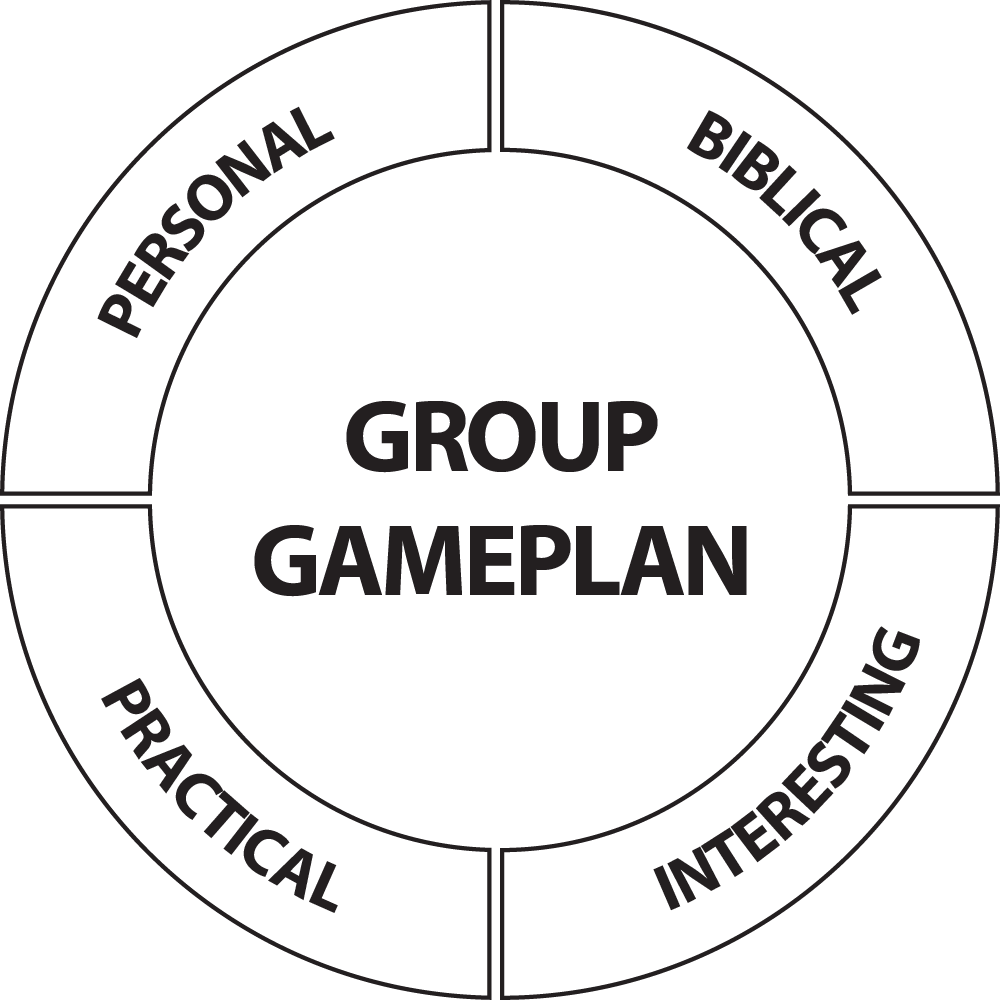
Because a great Bible group is not a mystery. It has parts. I have spent decades watching which parts matter, and there are four. I call them the Bible Group Gameplan.
Principle 01
Make it biblical.
A Bible group should open the Bible. That sounds obvious. But I have sat in many "Bible" groups where the Bible was hardly opened at all. Somebody throws out a topic ("tonight we are talking about forgiveness – what do you all think?"), and what follows is opinion sharing time. People share whatever they already thought when they walked in the door, and nobody goes home knowing the Word of God any better.
"For the word of God is living and active, sharper than any two-edged sword" (Hebrews 4:12, ESV). Our opinions are not.
So here is what I do instead. Somebody reads four or five verses aloud. And then I ask one simple question:
"So, what do you guys notice in the text here?"
Then I stay quiet.
People look down. They read the passage again. And then they start talking – about the text. I have used that question for years, week after week, and I honestly cannot remember it ever leaving us in an awkward silence. It works because almost anyone can answer it. Nobody has to interpret anything yet. Nobody has to share anything personal yet. And nobody has to guess which answer the leader is fishing for. They just have to notice.
Observation first. Interpretation later. Personal sharing later still. Most awkward silences are simply a good question asked at the wrong time.
Principle 02
Make it interesting.
Everyone loves to learn something new. So before the meeting I prepare two or three small nuggets – things that made me think "wow, that's interesting, I didn't know that" when I found them. A detail from a commentary. Something from a Bible course I watched that week. Then I drop them into the conversation where they fit. Not as a lecture at the start – if the leader talks for the first four minutes, the group goes passive and stays passive.
A good group evening becomes a great one when everyone goes home having learnt something.
Principle 03
Make it practical.
After the group has really looked at the text – not before – you ask the other question: "so, what does this mean for us today?" And the discussion comes down to earth. Our week. Our families. Our walk with God.
Principle 04
Make it personal.
The hardest one, and the most rewarding. A group where people trust each other enough to share honestly – the answered prayers and the stubborn struggles, the wins and the failures – and then pray for one another. This one usually takes time, and the leader has to go first. But when a group gets there, you have something rare in this world: a group nobody wants to leave.
That is the Gameplan. Biblical. Interesting. Practical. Personal.
When all four are present, the engine is revving on all cylinders and the evening mostly carries itself. When a group feels flat, it is almost always because one or more of the four is missing.
"Great Bible groups are not the result of charismatic personalities. They are the result of a simple structure that guides the conversation in a healthy direction."
The course
Six lessons, under one hour all together.
The Bible Group Gameplan is a short video course – six lessons, less than one hour all together – where I teach the four principles and exactly how to run them.
- The observation question, and the question order that prevents awkward silence.
- How to prepare nuggets without over-preparing.
- How much the leader should talk (less than you fear, more than nothing).
- How to build the trust that slowly makes a group personal.
- What to do if your tradition "doesn't do small groups." (You have more groups in your church than you think. Committees count.)
- And practical advice for starting a brand-new group, including why you should make it time-limited – eight or thirteen weeks – because it is much easier to invite people into something with an end date.
The course lives inside Bibloy, my membership site for Christians who take the Bible seriously.
Why do we bundle a lot of Bible courses together with the Bible Group Gameplan in the same membership site? Principle 2 needs a steady supply of interesting material, and the Bibloy library is where you would get it: courses on the Gospel of John, the parables of Jesus in their original Jewish context, how to read the different kinds of literature in the Bible, and more. Watch twenty minutes on the passage your group is studying next week, and you will usually walk in with more good material than you can use.

Get access now to the Bible Group Gameplan, plus 7 more courses in the Bibloy library:
How to start
01
Watch the course.
Six short lessons. One afternoon, or one lesson a day for a week.
02
At your next meeting, read five verses and ask the question.
"So, what do you guys notice in the text here?" Then wait. Let people read it again. This is where most leaders feel the change first.
03
Bring two nuggets.
Prepare them from a commentary, or from a Bibloy course on your passage. Drop them in where they fit.
04
Be patient with the personal.
Trust grows slowly. You go first. Prayer at the end of every meeting is where it usually starts to show.
So who am I?
My name is Reimar Vetne. I am currently pastoring two churches in Norway, and our Thursday Bible group is honestly one of the best hours of my week. I hold a BA in theology and an MA and PhD in New Testament, and I taught New Testament at universities for six years, training pastors and young Christian leaders.
But the credentials are not why I made this course. I made it because I love Bible groups. Fellowship happens in groups. In a church service we mostly look at the back of each other's heads. Around a table, people open the Word of God together, learn together, pray for one another, and share life. Jesus prayed that his followers would be one the way he and the Father are one (John 17). In my experience, that kind of closeness grows best around a table.
Now, this is normally where a sales page would show you a wall of testimonials. I do not have a wall of testimonials for this course yet. It is newer than my preaching material, and I have only recently begun gathering group leaders' stories. I would rather tell you that plainly than dress the page up.
What I can offer you is this: the method is not a theory I wrote at a desk. It is what I do every Thursday, at a real table, with real people, working through a book of the Bible together, a few verses at a time. It is what I have watched work – and fail, when a principle goes missing – in groups across many denominations for decades. My own mother is in a monthly neighborhood Bible group with folks from several churches, working chapter by chapter through the Bible together. The four principles are the same at every one of those tables.
And if you use the Gameplan and your group changes, write to me. I read every reply, and I would love to hear what happened.
For you if
- You are about to lead a Bible group for the first time, and you are more nervous about it than you let on.
- You already lead a group, and it has gone a little flat. You want the meetings to feel alive again.
- You are a pastor or ministry leader who wants more Bible-centered fellowship happening beyond the pulpit, and lay leaders who thrive.
- You love God and love people. That is the entire entry requirement.
Not for you if
- You mainly want an audience. A group is not a pulpit, and this course will keep handing the conversation back to the people around your table.
- You want a script to read aloud. The Gameplan is a way to lead a conversation, not a manuscript that does the talking for you.
- You are not willing to be patient. Trust in a group grows slowly, and no technique hurries it much.
The investment
$7/month.
Included when you join Bibloy:
- The Bible Group Gameplan course – all six lessons.
- The full Bibloy course library for your own preparation – the Gospel of John, the Parables of Jesus, Hermeneutics, Christian spirituality, and more.
- Every new course I add while you are a member.
Cancel any time. Some members join for the Gameplan, finish it, and leave. Others stay for the library. You decide depending on what you need.
And a 14-day "try it and see" guarantee: if this training does not help your small group thrive, write to me within the first two weeks and I will refund you personally.
You will sit down with your group again soon.
The question is whether that meeting will be as spiritually rewarding for everyone as you hope.
One small change in the way you ask your next question may make a noticeable difference at that very meeting. Read five verses. Ask what people notice. Stay quiet a little longer than feels comfortable.
If it is not the right time to join, the door to Bibloy is always open. You can come in whenever you want.
I hope your next meeting is the one where the silence breaks.

Questions you might be asking.
Do I need a theology degree?
No. You need a love for the Word of God and a love for people. The Gameplan handles the rest – the observation question does not require Greek.
Do I need to be an extrovert?
No. Introverts and extroverts make equally good group leaders. The set of questions you will learn carries the evening, so your personality does not have to. Some of the best group leaders I know are quiet people who ask good questions and then genuinely listen. What matters is that you love God and love people, and want to make a safe place where the group can grow together as disciples of Jesus.
I am a pastor with theological training. Is this too simple for me?
I think you will enjoy it. In my experience even seasoned pastors unconsciously drop one of the four elements – often the personal one – and the group loses its life without anyone knowing why. The Gameplan puts words on something you already half-know, so you can see which element is missing.
How much time does this take?
The course is under one hour, watch it on-demand. The goal is less stress, not more load. After that, preparing a meeting is mostly finding your two or three nuggets – twenty or thirty minutes, less if you use the Bibloy library for it.
What if my church tradition is not "small group friendly"?
I have heard that from people in nearly every denomination, but the truth is that small groups and fellowship is a biblical concept. The early church started with house congregations, not large church buildings. You already have groups – a midweek prayer meeting, an adult Bible class, committees, ministry teams. The Gameplan works in all of them, whenever you open the Word of God together.
What if I am starting a group from scratch?
The final lesson covers it. My main advice: make it time-limited. Invite people to eight or thirteen weeks, then take a break and decide together what comes next. It is much easier to join something with an end date, and a good group usually re-ups on its own.
Can I cancel?
Yes, any time, just email us or send a DM inside the membership site. And inside the first 14 days, write to me and I will refund you personally.
Cancel any time. 14-day money-back guarantee.